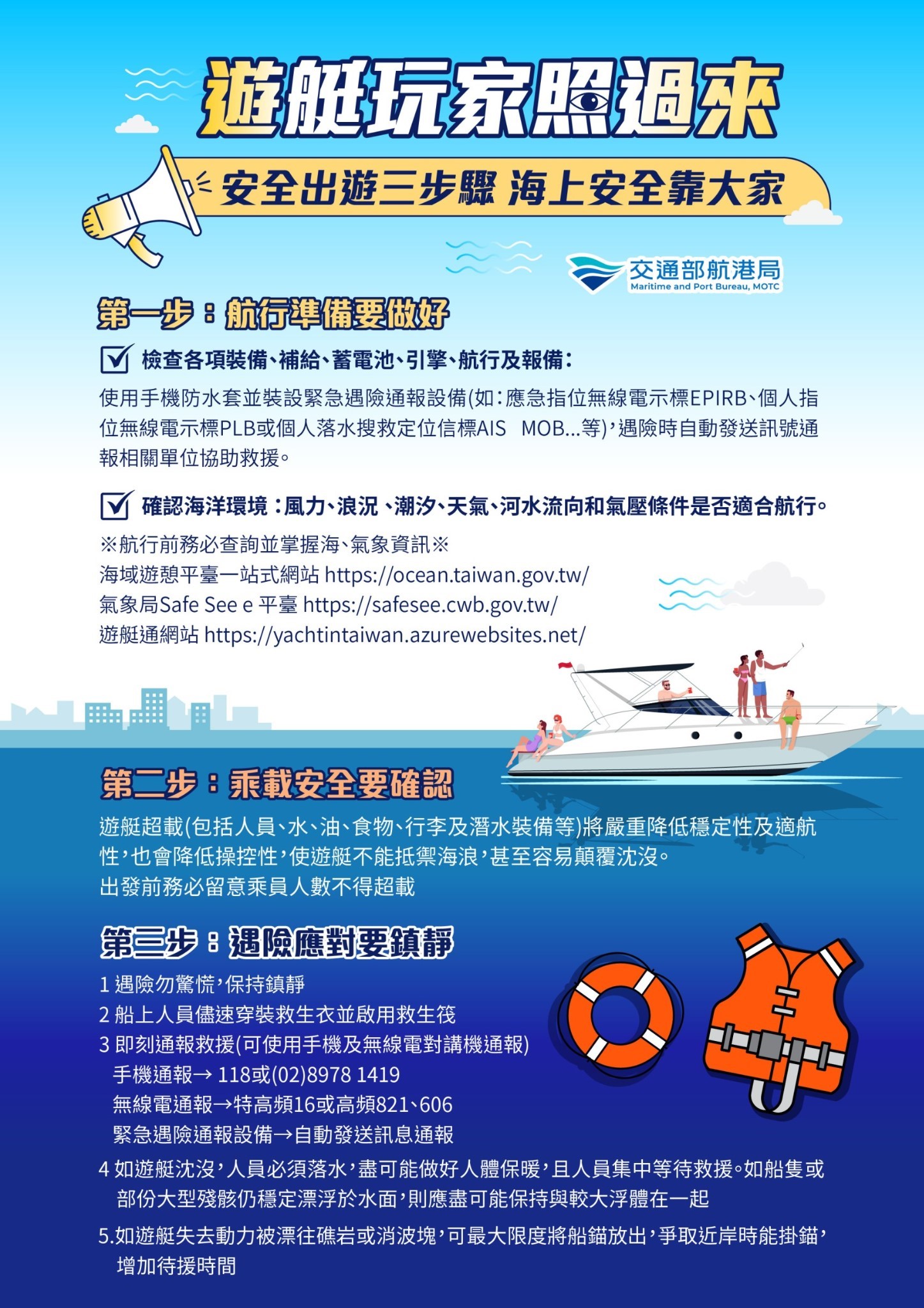
The MPB noted that yacht passengers and enthusiasts tend to neglect safety preparations because of the excitement of traveling. If passengers lack safety knowledge, they cannot manage emergencies appropriately. In recent years, yacht capsizing incidents have been reported. To reduce the risk of accidents and improve the safety of yacht activities, the MPB designed a poster describing three steps for ensuring a safe yacht trip. This poster aims to educate yacht enthusiasts and general passengers about the necessity of following yacht safety procedures, performing equipment checks, and being fully prepared to ensure a safe trip.
The three steps are detailed as follows. Step 1 is being prepared. Prior to a trip, operators should check whether their yacht’s equipment, supplies, storage batteries, engine, and navigation and reporting devices are in order. Additionally, they should check the maritime environment; that is, whether the wind, wave, tide, weather, river flow direction, and air pressure conditions are suitable for voyaging. Step 2 is performing pre-departure load safety checks. Overloading a yacht with passengers, water, gas, food, luggage, or diving equipment can severely comprise its stability and seaworthiness, thereby compromising its ability to protect passengers from sea waves and increasing the risk of capsizing and sinking. Step 3 is staying calm during emergencies. Numerous emergencies can occur at sea. During an emergency, one should stay calm, ensure that all passengers are wearing life jackets, board a life raft, and call for rescue immediately. To report an emergency through a mobile phone, dial 118 or (02)8978-1419; to report an emergency through a wireless device, select ultrahigh frequency 16 or the high frequencies 821 and 606. Alternatively, an emergency reporting device can be used to automatically transmit signals during an emergency.
If a yacht sinks and its passengers must jump into the water, ensure that they maintain their body temperatures and stay together in a group while they wait for rescue. If the yacht or a considerable portion of it is still afloat, stay close to the wreckage. If a yacht loses its power or is in danger of colliding with reefs or tetrapods, drop the anchor if possible, preferably near the shore to increase the time available for rescue.
The MPB would like to remind yacht passengers and enthusiasts to review and follow proper safety procedures and make the necessary preparations before setting sail to ensure a safe and enjoyable trip.
Contact Person: Section Chief Yi-Chiao Huang, Maritime Affairs Division
Tel.: 02-89788036
Translation of the attached poster(Fig. Three steps to ensure a safe trip)
Attention Yacht Enthusiasts
Ensure your safety at sea by following these three steps:
Step 1: Be prepared
☑ Check your equipment, supplies, storage batteries, engine, and navigation and reporting devices
Use waterproof pouches for your mobile phones and install emergency reporting systems (e.g., emergency position-indicating radiobeacon [EPIRB], personal location beacon [PLB], and personal overboard search and rescue systems such as the automatic identification system [AIS] and man overboard beacon [MOB]). During an emergency, these systems automatically transmit signals to the relevant units to call for rescue.
☑ Check the maritime environment: Check to ensure that the wind, wave, tide, weather, river flow direction, and air pressure conditions are suitable for voyaging.
Check and review the weather and marine weather situations prior to setting sail (mandatory)
Ocean website:
Safe See online platform (of the Central Weather Bureau):
Yacht In Taiwan website:
Step 2: Perform a load safety check
Overloading a yacht with passengers, water, gas, food, luggage, or diving equipment can severely comprise its stability and seaworthiness, thereby compromising its ability to protect passengers from sea waves and increasing the risk of capsizing and sinking. Prior to a voyage, please ensure that the number of passengers does not exceed the maximum limit (mandatory).
Step 3: Stay calm during an emergency
1. Stay calm during an emergency
2. Passengers must put on their life jackets immediately and board a life raft
3. Call for rescue immediately using a mobile phone or a wireless handheld transceiver
To report an emergency through a mobile phone Dial 118 or (02)8978-1419
To report an emergency through a wireless device Select ultrahigh frequency 16 or the high frequencies 821 and 606
To report an emergency through an emergency reporting device Such devices automatically transmit emergency signals
4. If a yacht sinks and its passengers must jump into the water, ensure that they maintain their body temperatures and stay together in a group while they wait for rescue. If the yacht or a considerable portion of it is still afloat, stay close to the wreckage.
5. If a yacht loses its power or is in danger of colliding with reefs or tetrapods, drop the anchor if possible, preferably near the shore to increase the time available for rescue.